Granville wilt
scouted July 1, 2026
- Scientific Name
- Ralstonia solanacearum
- Background
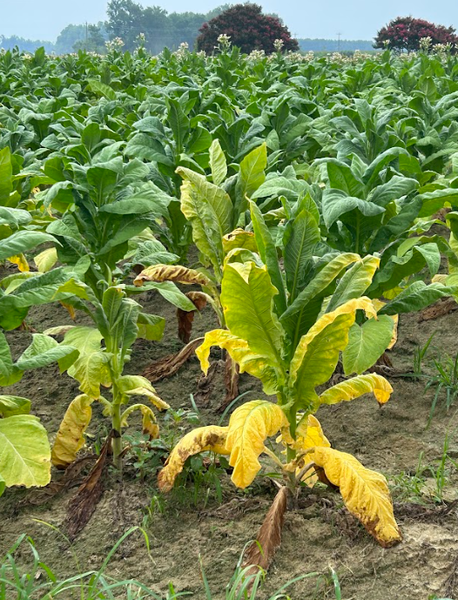
- A tobacco field, variety NC960, was being scouted, and it was observed that 15% of the field was affected by stunting in a localized area of the field. Plants in this area have abnormal root systems. A sample was submitted to the PDIC for diagnosis and the NCDA for nematode analysis.
- Conclusion
- The issue was identified as Granville wilt, also known as bacterial wilt of tobacco. This disease is caused by Ralstonia solanacearum and is endemic to the southeastern United States. Symptoms include wilting and yellowing of younger leaves, often on one side of the plant. As the disease progresses, scorch-like symptoms may develop along leaf margins and between veins, followed by plant collapse. Warm temperatures above 80°F and heavy rainfall favor rapid disease development. A common sign of this pathogen is white bacterial streaming from the stem when it is cut and placed in water. Management of Granville wilt relies on an integrated pest management approach that includes resistant varieties, crop rotation, and chemical control strategies.
- Resources