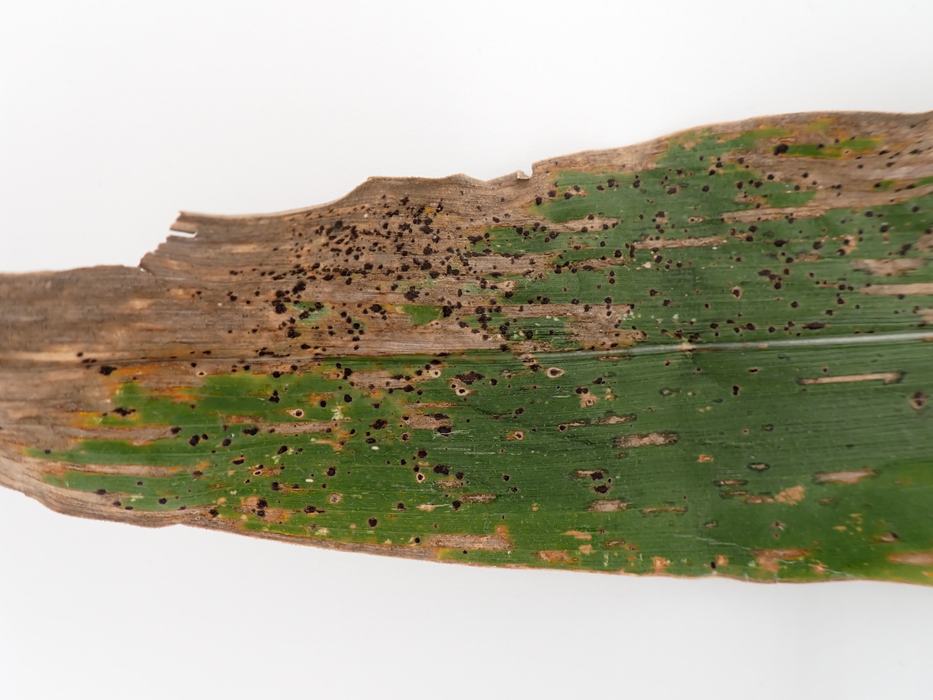
Tar spot
scouted Aug. 26, 2026
- Scientific Name
- Phyllacora maydis
- Background
- In August 2026, signs of black circular- to oval-shaped fungal structures (stromata) were observed on corn (Zea mays L.) leaves on Dekalb 68-35, Dyna-Gro D60TC45, and Revere 1307 in multiple fields in Randolph County, North Carolina. Signs were observed on only a few plants within the larger field, with disease affecting 5 to 80% of the field and 1 to 60% severity on individual leaves. In addition to the fungal structures, the green leaves also exhibited small tan specks on approximately 40% of the individual leaves. A sample was submitted to the PDIC for diagnosis
- Conclusion
- The black stromata were identified as tar spot. Tar spot is caused by the fungus Phyllacora maydis. It causes round to irregularly shaped black structures (stromata) on the upper and lower surfaces of corn leaves and are embedded in the tissue. Tar spot development is generally favored by moderate temperatures (60-80°F), humidity greater than 85%, and leaf wetness for more than 7 hours per day. When disease develops late, after R4-R5, yield impacts are often minimal.